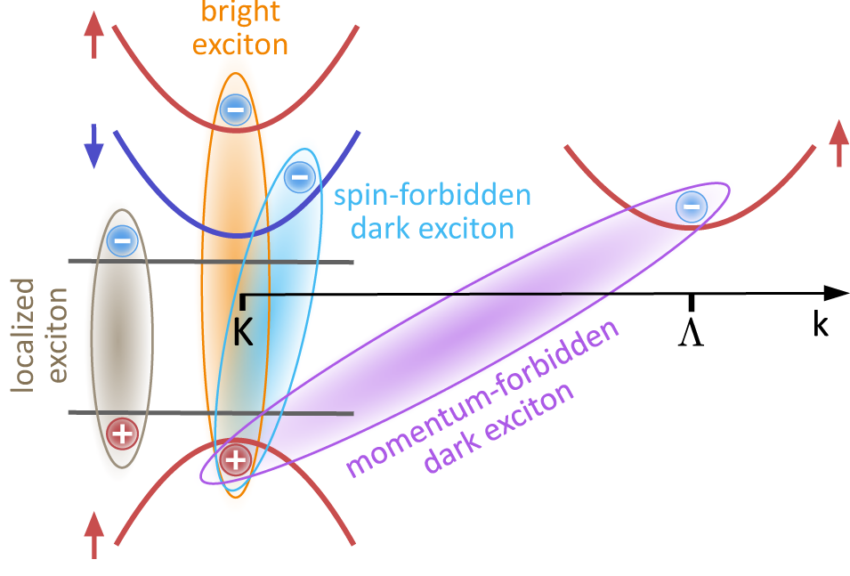
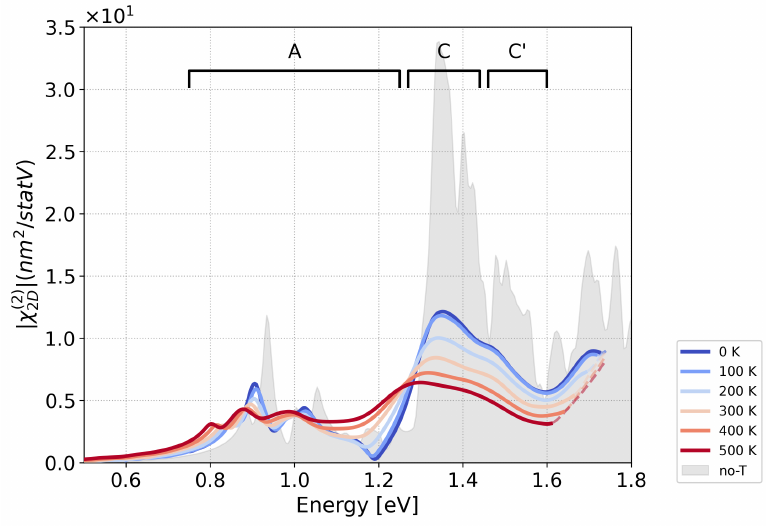
YamboPy 0.7 has been released!Yambopy is a python package providing additional postprocessing and data management functionalities for Lumen (Yambo) and Quantum ESPRESSO. In this new version you will find:*) new exciton postprocessing including symmetry analysis, spin-matrix elements*) new tool to analise dipoles*) exciton radiative lifetimes*) exciton-phonon coupling*) new function for nonlinear optics post-processing The code…
Ford documentation is online
Ford documentation for the Lumen file is online at:https://www.lumen-code.org/ford/index.html We are working to document all files and subroutines of the code in tight connection with theory and mathematical formulas.
Lumen code listed among software using ELPA
Starting from the last versions, Lumen officially support ELPA library:https://elpa.mpcdf.mpg.de/ELPA_USED.htmlELPA is a library that to provide highly efficient eigenvalue solvers for Petaflop systems, and Lumen use it in the solution of the Bethe-Salpeter Equation. If you computer cluster has this library installed you can link it to Lumen to speed up your calculations.Performance analysis on…
Lumen 2.0.1 – bug-fixes release
A new release of the Lumen code is available here:https://gitlab.com/lumen-code/lumen/-/releases/2.0.1 This release contains mainly bug-fixes to the previous release without new features. Release notes are available at: Release notes 2.0.1
Symposium: theory and modelling excited states
We are pleased to announce that we are organizing a mini-symposium entitled:‘Theory and Modelling of Excited-State Properties in Solids and Nanostructures’at the Condensed Matter Days (JMC) 2026, which will take place in Toulouse from 26 to 30 October.https://jmc2026.sciencesconf.org Registration will open in the spring and we hope to see many of you there! Invited speakers:Fabienne…
New tutorial on Floquet formalism for non-linear response
A new tutorial is available in the wiki web-page on the Floquet formalism for the calculation of non-linear response functions. Respect to the standard real-time approach Floquet formalism is much faster but at present it is limited to the independent particle approximation with or without scissor operator. In the tutorial we show how to calculate…
Lumen robots are online!
After several months, our Robot Farm is finally online. Here you can see the computers on which we test Lumen and all the new branches and developments. https://www.lumen-code.org/robots/
Lumen 2.0
Lumen 2.0 is available for download here:https://gitlab.com/lumen-code/lumen/-/releases/2.0.0 Lumen 2.0 is a fork of Yambo 5.3. In this version we kept the full compatibility with Yambo 5.3, and used the same name for the executables, but many new features as exciton-phonon coupling, Kerr spectroscopy etc… are present in Lumen 2.0. Moreover Lumen 2.0 include also different…
Frontiers in Ultrafast Phenomena in Quantum Materials Workshop 2026
The Frontiers in Ultrafast Phenomena in Quantum Materials Workshop 2026 will take place at the INFN–LNF Laboratories in Frascati, from Tuesday 21 April to Friday 24 April 2026. The event is organized by the TIMES Doctoral Network, funded by the European Union under the Marie Skłodowska-Curie Actions program. Its mission is to train a new…
New tutorial on double-grid approach for optical properties
Convergence of dielectric constant with respect the number of k-points can be very slow in many systems. For this reason in Lumen it is implemented a double-grid technique that speeds up convergence versus k-points with a computational cost comparable to the standard calculations. Here we provide a tutorial for this approach: https://www.lumen-code.org/wiki/index.php?title=Fast_convergence_of_dielectric_constant_with_double_grid The method for…